Omdia says the hammer has fallen on low-cost smartphones

Rising component costs and geopolitical crisis have prompted the analysts at Omdia to warn that smartphone sales will slow even as prices rise.
This tough environment also means low-cost, high-volume smartphones are disappearing as manufacturers lack access to the components to make these things while generating significant revenue.
What Omdia said
“The smartphone industry is currently going through a period of significant disruption, as vendors work to manage short-term component cost pressures as effectively as possible,” said Jusy Hong, Senior Research Manager at Omdia.
Please subscribe to The Core Apple news summaries here and support our work.
“Some vendors are gaining early-mover advantages by increasing component inventories to minimize the impact of future price hikes. Once the DRAM and NAND pricing starts to stabilize and plateau at a new level, the market is expected to enter a phase of stabilization, where the focus will shift back to other strategic priorities. This transition is expected towards the second half of 2027.”
What does Omdia expect?
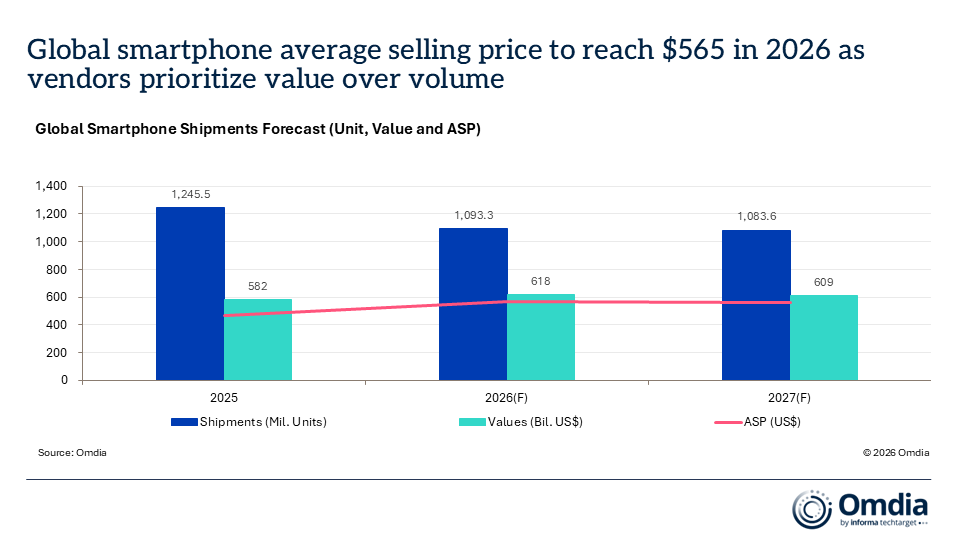
Omdia forecasts smartphone sales will decline 12.2% year-on-year (YoY) in 2026, dropping to 1,093 million units. This represents a decline of 152 million units compared with 2025.
Despite this shipment contraction, total market value is projected to grow by 6.1% YoY over the same period as retail prices climb. The global smartphone average selling price (ASP) is forecast to increase from $467 in 2025 to $565 in 2026. This 21% jump – equivalent to $98 – marks an all-time high in both growth rate and dollar value for the industry.
There is some good news. Omdia points to the most recent 80% price hike in memory, and additional increases about to strike, but predicts memory price growth will shrink to single figures in the second part of the year.
The hammer falls
“Vendors are also increasingly relying on wider business models and portfolios to strengthen operational resilience. Vendors and regions with a high dependence on budget smartphones as their primary customer engagement will be particularly exposed,” said analyst Runar Bjorhovde.
Apple, of course, has a strong position, he suggested.
“The strongest position will be held by vendors that can capture additional high-value and high-margin streams from each user. This will typically include cross-selling other ecosystem devices, upselling services and subscriptions that increase the lifetime user value, and expanding opportunities to monetize the installed base,” he said.
Omdia forecasts that the global smartphone market contraction will extend into 2027, although the shipment decline is forecast to slow significantly to 0.9%.
Please join me on social media at BlueSky, LinkedIn, or Mastodon, even better, please subscribe to The Core for your daily fix of human-curated Apple News.