Apple’s iPhone gains growth as industry falls 4.1%
At times I imagine there’s some excitement at Apple, as it’s almost as if the hard work the company has done over decades is paying off. After all, not only is the Mac now seemingly ascendant in the PC space, but the iPhone also goes from strength to strength.
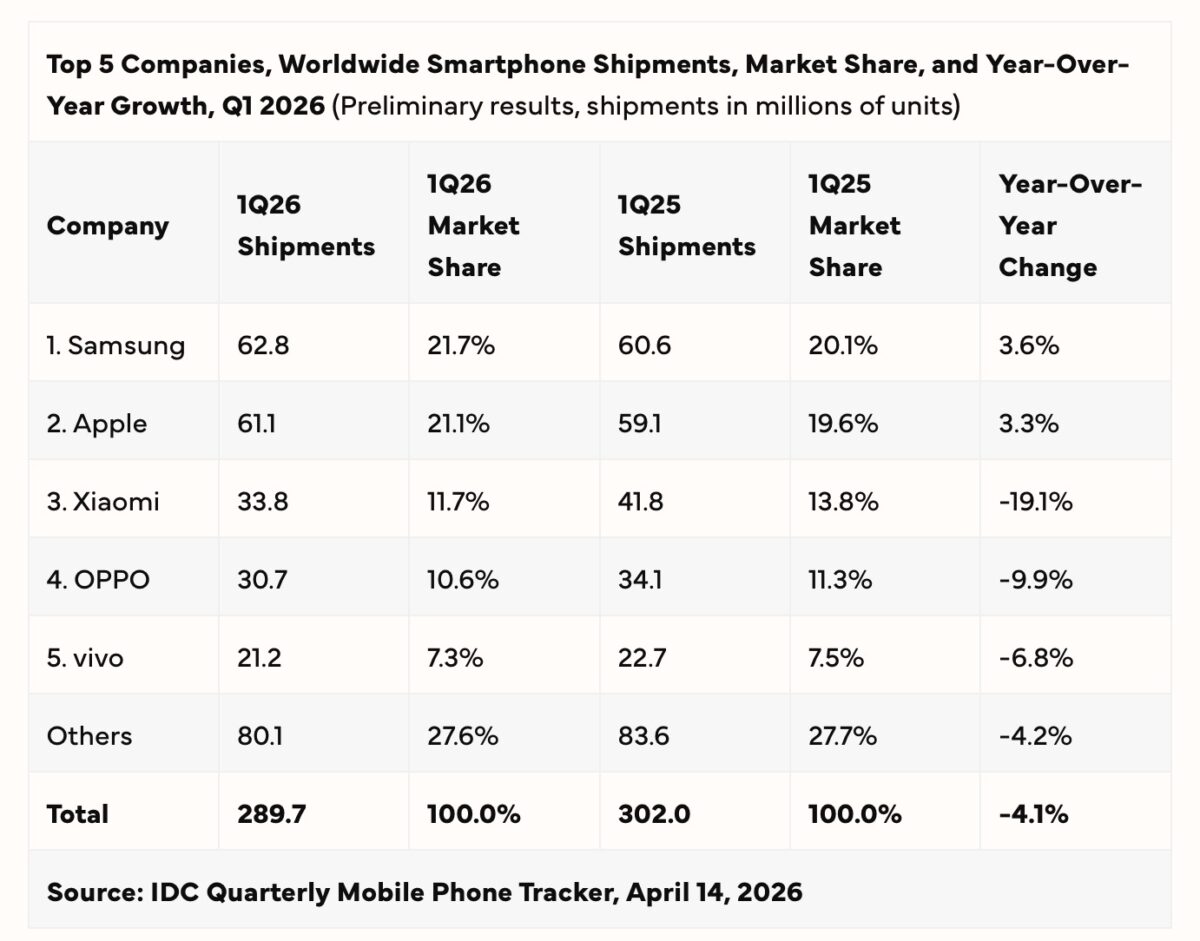
IDC tells us both Apple and Samsung saw growth far beyond the smartphone industry average once again this year. You see while preliminary data claims global smartphone shipments decreased 4.1% year-over-year to 289.7 million units in the first quarter of 2026 (1Q26), Apple and Samsung resisted that fall returning 3.3% and 3.6% increases instead.
Apple secured second place thanks to strong sales of the iPhone 17 series, which saw significant growth in China of over 30%. This led to a 3.3% year-over-year increase in global sales for Q1. “Although demand remains robust, supply disruptions and a reduction in channel support in some key markets have hindered growth,” IDC warns.
Samsung drew gains thanks to the Galaxy S26 Ultra. Everyone else saw decline, particularly Xiaomi, which saw a 19.1% decline in sales.
What the analysts said
“This was a challenging quarter for all smartphone players as they figure out a balance between profitability and growth and stabilization within home markets vs overseas expansion amid the constrained supplies and price pressure. Apple and Samsung benefited from their dominance in the premium segment where they strategically held back price increases, while others such as Xiaomi, OPPO, and vivo made concerted efforts to shift share to higher price bands,” said Kiranjeet Kaur, associate director of Consumer Devices, IDC.
“Their resilience will continue to be tested over the next few quarters as they optimize and streamline their portfolio and respond with agility to market and supply chain changes. The strong footprint they had in Asia will be challenged as the low-end segment is eroded due to the price increases while expansion in Europe will face increasing competition from Apple and Samsung.”
There’s trouble ahead
“The 4% decline in the market is just a sample of what’s to come as the memory situation intensifies on all fronts,” said Anthony Scarsella, research director for Mobile Phones, IDC. “Developed markets like the US that focus on premium models and with incentives such as trade-in and financing will be less susceptible to the overall impact of price increases. However, emerging markets that focus on sub-$200 devices will offer consumers very few options as the growing cost of memory components will represent a larger challenge than what the pandemic delivered over five years ago.”
You can follow me on social media! Join me on BlueSky, LinkedIn, and Mastodon.