Morgan Stanley: Apple’s App Store changes ‘more bark than bite’

I did say Apple’s mooted potential decision to permit third party app stores on iOS won’t change the world much, but should get regulators off the company’s back. Morgan Stanley Apple analyst, Erik Woodring, seems to agree.
‘More bark than bite’
In a note to clients, Woodring describes the arrangement as “more bark than bite”. He says consumers “overwhelmingly” prefer the App Store to its alternatives, and observes that sideloading has seen limited adoption on other platforms. It’s just too complex for most people to bother.
What this translates into for Apple is, he says, perhaps a 1% App Store revenue reduction and a limited impact on EPS, at worst. In contrast the vast volume of sales it would lose if it failed to follow the EU-driven mandate to open up, it’s a good deal.
You need good reasons to travel
“Even if this potential change were spread globally, the core question becomes whether consumers decide to speak with their wallets and abandon the App Store for alternative options,” he wrote.
“Our survey work shows a very low likelihood of this scenario playing out, as Apple’s customers have long prioritized the security, centralization, and convenience that the App Store brings.”
The benefits of taking this action should be a reduction in concern around potential regulatory action, and Morgan Stanley told clients, “we’d be buyers of any negative stock reaction to this news.”
The big contrast is with Android, where sideloading has been allowed since launch, but adoption has remained in “low single digit % adoption”.
He also points out that Apple will be likely to require a fee for sales of sideloaded apps, bringing on the question which is fundamental to all these shenanigans: “How much is it right to charge?”
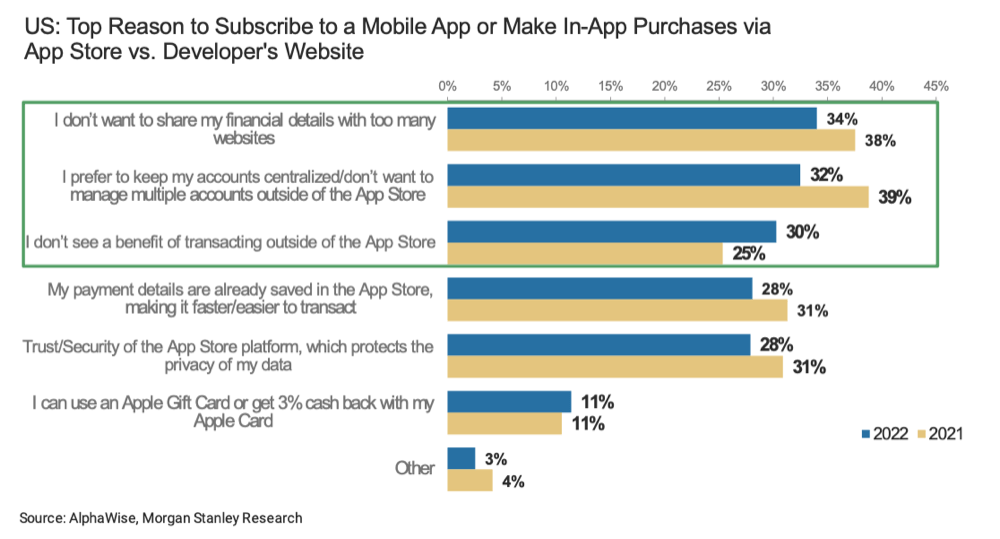
People see benefit in the App Store approach. (Image from Morgan Stanley data)
Why do we want to do this?
“From the consumer perspective, we see very little demand for alternatives to the App Store given the unmatched security, ease of use (centralization), and reliability the App Store provides,” the analyst wrote.
Woodring cites MS data to show that under 30% of iPhone owners are extremely likely to purchase a mobile app directly from a developer website vs. the App Store.
iPhone owners would also need to be motivated to use these services, in part because they want to keep their financial data secure. In the absence of any good reason to do so, most Apple users see no benefit to making transactions outside the store.
That, of course, is because, for most of us, there is no benefit. The benefit sits with those selling thing they want to make more profit on. In my opinion. I don’t think anyone campaigning for Apple to take this step show much interest in social justice. I could be wrong. But I’m probably not.
[Also read: Apple’s App Store has at last agreed to go Dutch for dating]
No one does this stuff
“While accurate data on the number of applications hosted on alternative app stores such as the Amazon Appstore, Huawei App Gallery, Epic Games Store, Galaxy App Store, and others, is relatively limited, publicly available data suggests most alternative app stores have a much more limited app library than the App Store,” he wrote. Developers choosing to use external stores will need to maintain and develop apps for use across those stores, which will not be terribly attractive to small businesses.
Please follow me on Mastodon, or join me in the AppleHolic’s bar & grill and Apple Discussions groups on MeWe.