Jamf brings powerful AI Governance solution (updated)
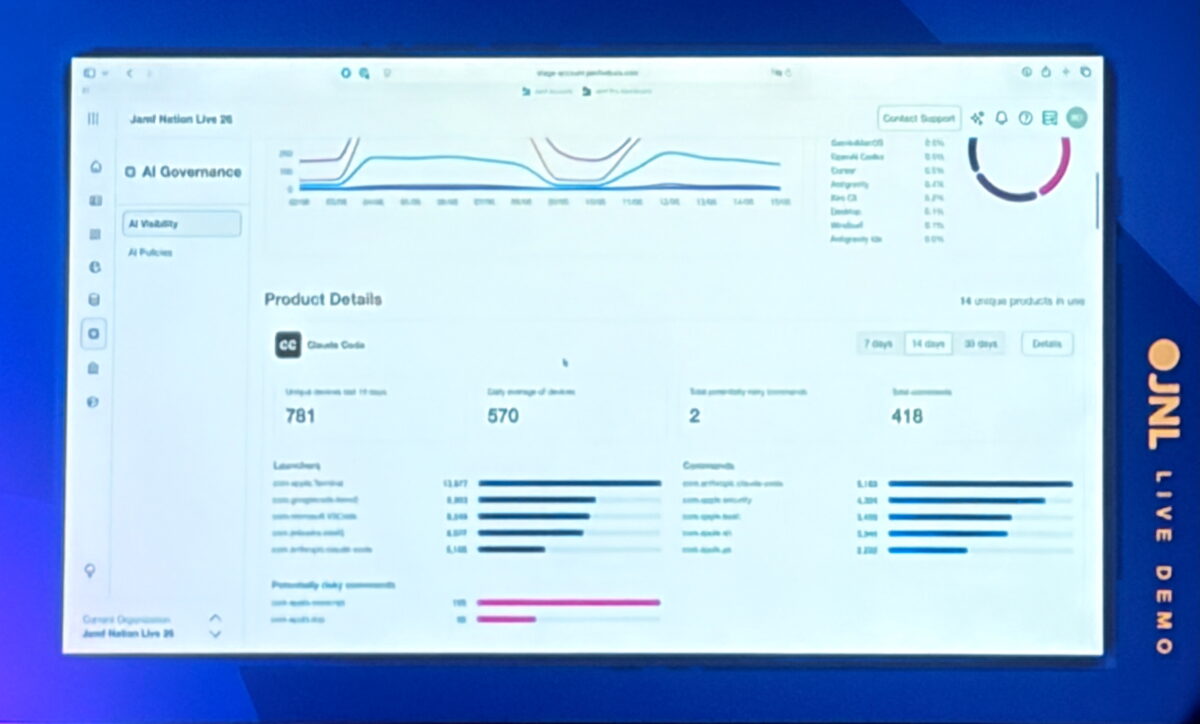
London: Jamf CEO, Beth Tschida is in London, UK today to join the Jamf Nation Live get-together there. During her keynote speech, the company’s leader announced AI Governance, a powerful new solution to help IT manage AI on their networks.
AI Governance: Right product, right time
This is a well-timed release on the part of the company:
- A very recent survey claims almost two thirds of officer professionals have used AI tools or services at work, even when they knew they weren’t permitted to do so.
- Analysis from TRG Datacenters says 67% of UK’s organizations report being unable to track what employees are sharing with AI services.
- A recent Jamf survey found t 72.9% of organizations have already deployed AI in some form, but more than 22% of respondents have already experienced an AI-related incident.
Clearly, this is a governance and management nightmare, and it’s a use pattern that is growing, not slowing.
“AI adoption across the enterprise is moving faster than existing technology policies can keep up,” said Beth Tschida, CEO at Jamf.
Managing to AI success
Curiosity about AI is high, which is why any student of human nature will tell you humans will continue to use these tools, which means the challenge for IT is less about prevention and more about finding ways to enable such use, while protecting company assets and data.
It’s also about protecting the company from AI-related bill shock as the cost per token increases even as usage grows, at least if you’re an Apple-using shop that also uses Jamf device management.
“Organizations need governance that matches the way AI tools actually operate on Mac,” said Tschida. “This means visibility into what’s running, policy controls enforced directly on the endpoint, and reporting that helps security teams demonstrate compliance. Our AI Governance capability delivers that natively from the same platform customers already trust to manage and secure Apple devices,” she said.
Please subscribe to my daily news summary on Substack
What AI Governance can do
AI Governance uses similar telemetric technology to Jamf Protect, to give enterprises visibility, control and governance for AI tools running across managed Mac fleets. IT can use it to set and restrict AI use.
In a release, Jamf explained AI Governance performs the following critical capabilities:
- Visibility: AI application visibility and shadow AI discovery surface AI tools, agents, and LLM runtime across the fleet (including CLI-based developer tools and background agents) using Jamf Protect telemetry which is native to Apple Silicon. No new agent is required.
- Control: AI access policy controls let IT define sanctioned tools, deploy access policy at scale, and scope different postures to different teams including three curated default postures (Maximum Security, Balanced, and Developer-friendly). Vendor-correct configurations can be applied automatically at scale.
- Governance: An executive AI posture report provides CIOs and CISOs with a summary of AI usage. The capability offers SIEM compatibility and is designed to assist companies in reporting against their existing compliance frameworks.
The tool includes reporting, management, and audit services, and will let IT identify which AI models are being used on their networks and also see the extent of that use. Identifying models running across your fleet isn’t always easy, as they don’t always show up in app inventories of DNS logs, so Jamf has created tools to surface AI and client usage.
The tool also permits service deployment and permissions privileges and will generate audit-ready reports as required. You’ll be able to find out more about AI Governance at this location, once it is announced later this week – the product is expected to ship at the end of June 2026.
“If you know how people are running AI across your fleet, you figure out how to optimize that use. We can be a huge enabler for everyone that’s using our product to get to where they want to go with AI,” said Tschida.
Jamf PR in full follows:
Jamf to launch AI Governance, a first-of-its-kind native AI control plane for Mac
New capability gives enterprises visibility, control and governance for AI tools running across managed Mac fleets, addressing today’s gap between usage and confidence
On Wednesday June 17, Jamf is announcing the upcoming release of AI Governance, a new capability within Jamf for Mac that enables IT and security teams to discover AI tools, enforce policy controls, and generate audit-ready reporting. This move delivers the most comprehensive native, OS-level AI governance controls for Mac to date. AI governance from Jamf will be Generally Available on June 30, 2026.
With launch support for Claude Code, Claude Desktop, and Open AI Codex, the capability provides deep governance coverage across model access, network permissions, file system controls, MCP server restrictions, and other vendor-specific AI configurations. A vendor control tracking engine continuously monitors supported AI platforms for new or updated controls, helping organizations keep governance policies current as AI tools rapidly evolve.
The only native Mac control plane for enterprise AI
AI tools run natively on Apple Silicon and operate as background processes that existing network proxies and cross-platform endpoint tools cannot fully see or govern. No existing tool unifies MDM authority, deep AI tool configuration coverage, and a workflow that translates governance intent into vendor-correct configuration on macOS.
Jamf AI Governance closes that gap by deploying vendor-correct AI configurations natively, in minutes, through the Device Management plane that admins use today, delivering three capabilities across the solution:
- Visibility: AI application visibility and shadow AI discovery surface AI tools, agents, and LLM runtime across the fleet (including CLI-based developer tools and background agents) using Jamf Protect telemetry which is native to Apple Silicon. No new agent is required.
- Control: AI access policy controls let IT define sanctioned tools, deploy access policy at scale, and scope different postures to different teams including three curated default postures (Maximum Security, Balanced, and Developer-friendly). Vendor-correct configurations can be applied automatically at scale.
- Governance: An executive AI posture report provides CIOs and CISOs with a summary of AI usage. The capability offers SIEM compatibility and is designed to assist companies in reporting against their existing compliance frameworks.
“AI adoption across the enterprise is moving faster than existing technology policies can keep up,” said Beth Tschida, CEO at Jamf. “Organizations need governance that matches the way AI tools actually operate on Mac. This means visibility into what’s running, policy controls enforced directly on the endpoint, and reporting that helps security teams demonstrate compliance. Our AI Governance capability delivers that natively from the same platform customers already trust to manage and secure Apple devices.”
AI governance urgency is accelerating
The need for enterprise AI governance is accelerating as organizations rapidly deploy AI-powered tools across employee workflows. Jamf’s recently released AI Governance Survey found that organizations with deeply integrated AI are 40% more likely to report an incident than those still in the exploration phase, suggesting AI governance is quickly becoming an operational requirement rather than a future planning exercise.
Gartner® mentions, “With spending on AI governance expected to reach $492 million in 2026 and surpass $1 billion by 2030, organizations are reassessing the tools and strategies needed to stay ahead of both regulatory and operational risk.” Further, in its Top Cybersecurity Trends for 2026 report, Gartner also says that, “Cybersecurity leaders must identify both sanctioned and unsanctioned AI agents, enforce robust controls for each and develop incident response playbooks to address potential risks.”
Jamf’s AI Governance capability will be available on June 30 in Jamf for Mac with immediate support for Claude Code, Claude Desktop, and OpenAI Codex. Learn more about Jamf AI Governance athttps://www.jamf.com/solutions/ai-governance
You can follow me on social media! Join me on BlueSky, LinkedIn, Mastodon and subscribe to The Core.