Consumers spend almost half their gadget money on smartphones — report
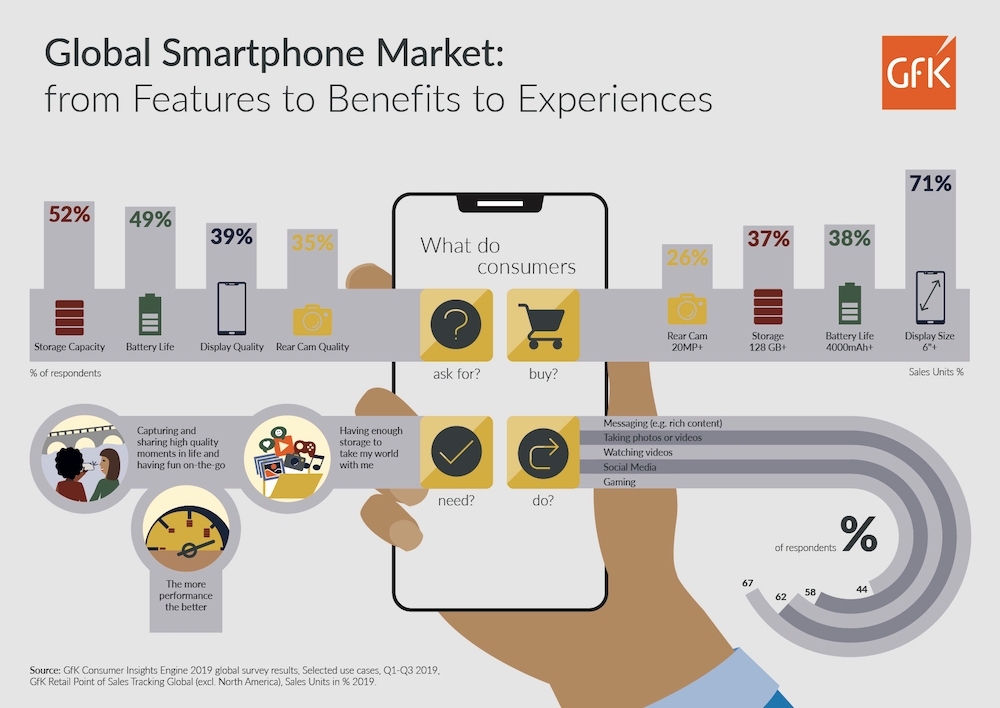
What consumers buy smartphones for in contrast to what they actually do with them.
While coronavirus may depress the market, smartphones will still account for “nearly half” of the consumer budget for tech and durables this year, claims analysis from GfK. And Apple’s AirPods are defining the next phase of this market.
Apple’s new industry: AirPods
The analyst firm notes that true wireless earbuds are one of the latest trends in this noting that this part of the market “achieved a triple-digit increase in 2019.”
This figures with my anecdotal experience, which is to witness increasing use of AirPods on every high street.
GfK states:
“Nearly every second headset sold on the market in 2019 was true wireless, which is twice as high as their share in 2018.”
It’s not entirely an Apple market, but the company has certainly secured a big slice of it – though competitors are playing the game:
“This market has attracted many new players, with more than 30 brands generating 80 percent of all units sold in 2019 globally,” GfK explains.
Wearables generally saw 29 percent unit growth in 2019.
“The increase in value terms was even more pronounced, reaching over 40 percent, driven by the high demand for smartwatches and wrist sport computers.
“With consumers increasingly concerned about their health, the introduction of functionalities such as blood pressure and blood oxygen measurement are gaining traction.”

The heart of the matter
Smartphones are the new rock ‘n’ roll
What’s really interesting is that smartphones have become the biggest investment consumers make in tech.
“Smartphones will again occupy nearly half of the consumer budget for tech and durable goods in 2020 and will generate a total turnover of €444 billion,” said GfK.
The analysts predict demand will stay stable with around 1.37 billion smartphones sold globally this year, the company said, warning that the impact of the coronavirus on global supply chains and production capacities could inhibit this.
“Impressing the consumers with groundbreaking innovations has been a challenge in recent years. Especially when it comes to the market for smartphones” said Pavlin Lazarov, GfK expert for Telecom.
“The interaction with what is probably the most personal device has increased to such high levels and with it the expectation for its hardware and performance. One can say that premium and performance have now become the standard…”

Sri Santhanam explains how the machine learning and low-power design of A13 Bionic make it the fastest chip ever in a smartphone.
What do people do vs what people buy
The report also has interesting insights into what features drive people to purchase smartphones in comparison to those they actually use.
Nuggets from this research feature in the infographic. Highlights include:
- The share of smartphones with a display of at least 6” has reached 70percent in unit terms in 2019, up from a share of 24 percent in 2018.
- Despite interest in cloud storage services, consumers stillsee internal storage as the most important feature when choosing a smartphone. 37% of allsmartphones sold in 2019 have 128GB of storage or more.
- 49% of consumers value battery life.
- 38% of devices sold in 2019 had at least 4,000mAh capacity.
- 44% of consumers value performance speed and graphics, particularly for games.

A new motion co-processor inside iPhones?
Getting ready for 5G
The spread of 5G is highly dependent on the country telecom infrastructure.
In South Korea one third of all smartphones sold in Q42019 were 5G-ready, while that share was at around two percent in Great Britain and Australia.
The biggest smartphone market, China, is catching up, with 5G devices accounting for 8% of all smartphones sold in December 2019.
The next phase? I think we’ll see smartphone dominance disrupted by new breeds of 5G-equipped wearable devices in the next three years.
Please follow me on Twitter, or join me in the AppleHolic’s bar & grill and Apple Discussions groups on MeWe.