Apple’s iPhone Ultra will grab 29.4% of foldable shipments in 2026 – IDC

Apple is expected to introduce its very own take on a foldable device in September.
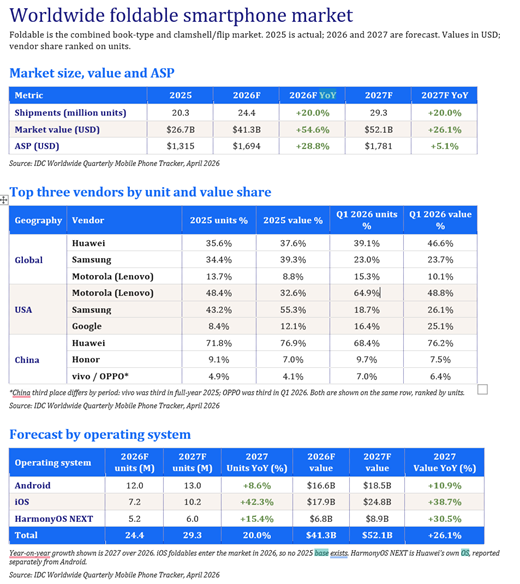
When it does, IDC expects it to take 29.4% of foldable shipments in 2026 and 34.9% in 2027, “making it the largest foldable brand within the first 12 months of entering the category,” IDC analyst Francisco Jeronimo wrote in a client note received by me.
Battle is already joined. Samsung is ready to beat it to the punch with the launch of its similarly designed ‘book-style’ foldable at a launch event next week.
This shows the company is “not sitting back and waiting for Apple,” said Jeronimo. It is worth pointing out that IDC earlier this year predicted Apple would grab 22% share with its first folding iPhone.
Apple v. Samsung: War of the folds
What’s at stake isn’t just dominance in the new device category, but also the drive to create and popularize a new high-price device tier, a step which is mandatory for all smartphone vendors as the economics of the industry continues to change.
Please subscribe to my human-curated daily Apple news summary on Substack. I’ve been watching the sector for decades and will keep you in the loop in less than five minutes a day.
“Strategically, this is one of Samsung’s most important foldable launches,” he said. “The company created the modern foldable category and remains one of its most recognisable brands, but it can no longer rely on first-mover advantage.” The company is expected to introduce a wider, passport-style foldable called Galaxy Z Fold 8, alongside the Galaxy Z Fold 8 Ultra and the Galaxy Z Flip 8.
The analyst pointed to some shortcomings of the new passport-style format, which Apple is also expected to adopt in its product later this year. This changes the basic proposition of a foldable smartphone. It provides a wider internal screen that’s better for many consumer and productivity tasks, but the format also creates new trade-offs, he observed:
- A compact, wide screen may be less suitable for extended typing when unfolded
- Scrolling and one-handed use may be more challenging than when using conventional folding devices – plus the keyboard occupies much of the display when folded.
- The folded device may also not fit every pocket.
“Samsung will therefore need to articulate clearly that this is a deliberately different product rather than an oddly proportioned replacement for the existing fold,” he explained.
What this means to Apple?
Apple is expected to use the same book format in its folding iPhone. When this is introduced the product will be Samsung’s biggest challenger in the space it currently dominates, in part because Apple is usually a catalyst for any product category it chooses to enter.
Based on market share expectations, IDC seems to think Apple will be a catalyst once again, anticipating 7.2 million units will be sold this year alone. (We’ve heard other reports Apple has ordered up to 10 millions of these devices to be made). Next year, Jeronimo anticipates 10.2 million sales of the iPhone Ultra. Overall, he thinks the foldable category will grow by about 20%, despite industry weakness elsewhere.
What about memory?
Samsung isn’t immune to accelerating component and memory prices. IDC already forecasts global smartphone shipments to fall 14% in 2026, the steepest annual contraction on record, driven by steep price increases across all smartphone segments.
“However, Samsung is one of the few vendors able to make higher prices stick. IDC expects Samsung to grow market share in 2026 even as Android as a whole falls 21%, helped by secured memory supply,” IDC said. One more thing, of course, is price. Like Apple, Samsung clearly hopes to build a new price tier in consumer imagination. IDC thinks it can succeed. “The devices will cost more, and Samsung is among the few positioned to charge more without losing the customer,” he said.
This is also true for Apple – and these market realities suggest we will see further solidification in the two-horse race that currently defines this part of the smartphone market.
You can follow me on social media! Join me on BlueSky, LinkedIn, Mastodon and subscribe to my daily Apple-related news summaries at The Core.