Apple innovates: Now it is 3D printing your Apple Watch
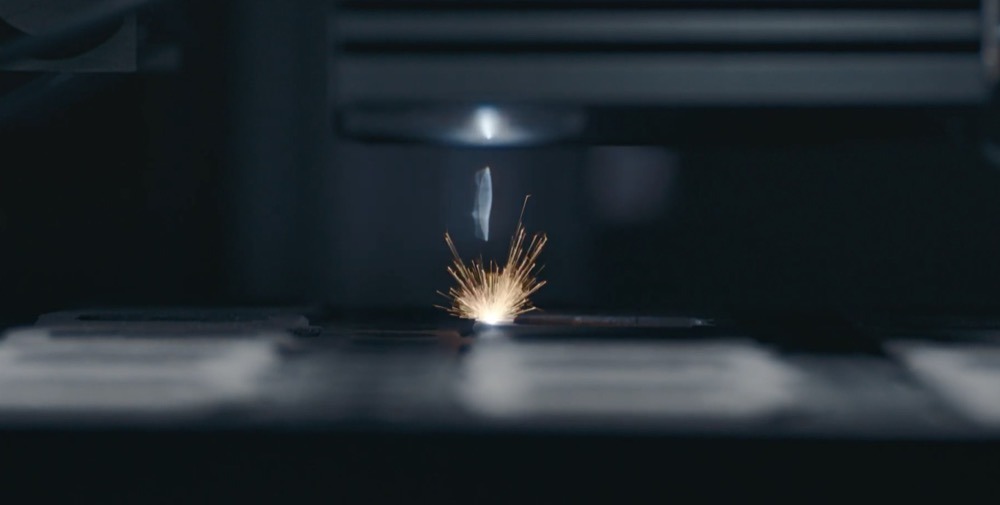
That small laser is printing an Apple Watch
Innovation isn’t just about what something can do, it is also about how that something is made.
Advanced manufacturing process tech is today’s Apple innovation story as the company takes the wraps off how it makes Apple Watch in the most advanced way possible – using 3D-printed titanium.
Apple is 3D printing time
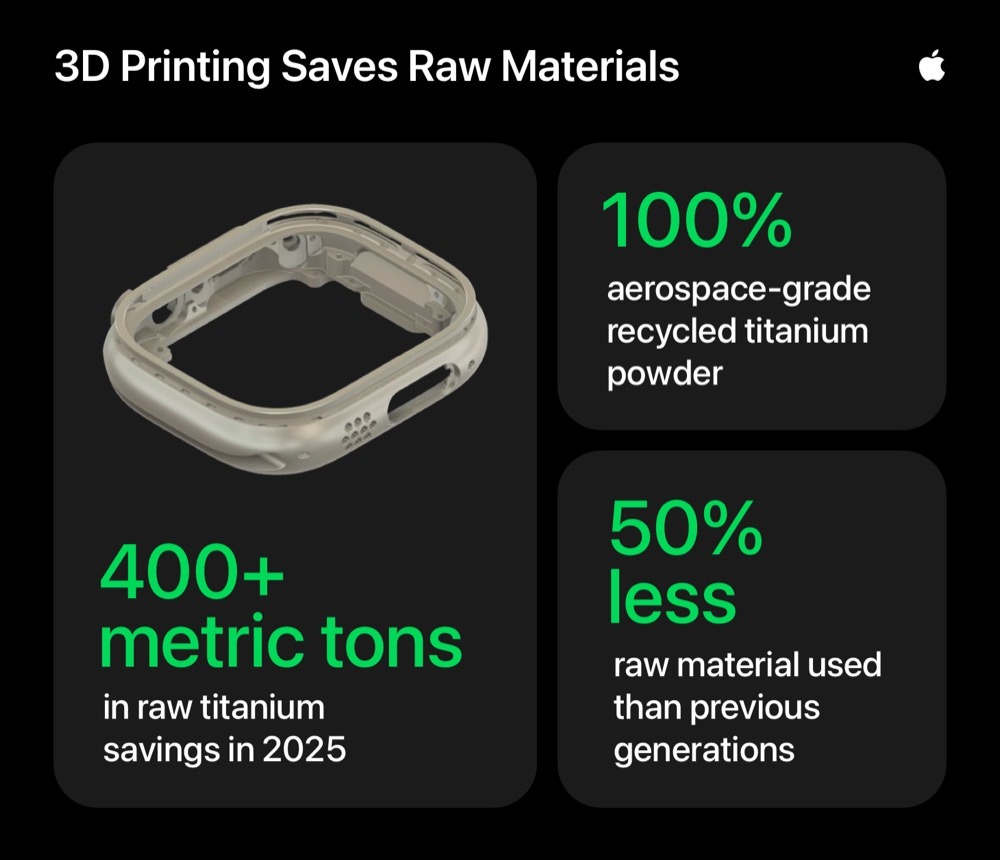
This year, all Apple Watch Ultra 3 and titanium Apple Watch Series 11 cases are 3D-printed with 100 percent recycled aerospace-grade titanium powder, an achievement not previously considered possible at scale.
When developing the product, Apple’s designers thought about how 3D printing tech could be used to produce the enclosures for the device. That’s a big deal of innovation right there, combining 3D print tech with metallurgy and metal printing.
“It wasn’t just an idea — it was an idea that wanted to become a reality,” Kate Bergeron, Apple’s vice president of Product Design says in a press release.
“Once we asked the question, we immediately started testing it. We had to prove, with continuous prototyping, process optimisation, and a tremendous amount of data gathering, that this technology was capable of meeting the high standard of quality we demand.”
The results had to be high quality. The company wanted to ensure the new manufacturing tech didn’t create any compromise on quality. They had to have that pristine polished finish, they devices had to be durable, and had to be environmentally positive.
Apple 2030 – toward a zero carbon future
“At Apple, every team holds environment as a core value,” says Sarah Chandler, Apple’s vice president of Environment and Supply Chain Innovation. “We knew 3D-printing was a technology with so much potential for material efficiency, which is critical for getting to Apple 2030.”
The move to use the process in Apple Watch manufacturing is likley to be an important step towards Apple’s goal to become carbon neutral across its entire footprint by 2030.
The way it works is interesting. The watch bodies are printed layer by layer gets printed until they are as close to the final shape needed as possible.
Apple explains that while historically, machining forged parts is subtractive, requiring large portions of material to be shaved off, this approach to making lets them create the devices using half as much raw materials. The company estimates over 400 metric tons of raw titanium will be saved this year in consequence.
“A 50 percent drop is a massive achievement — you’re getting two watches out of the same amount of material used for one,” Chandler explains. “When you start mapping that back, the savings to the planet are tremendous.”
It turns out that Apple has been experimenting with 3D printing while the industry itself was starting to take off. “We’ve watched this technology mature for a long time and seen its prototypes become more representative of our designs,” says Dr. J Manjunathaiah, Apple’s senior director of Manufacturing Design for Apple Watch and Vision.
“Using less material to make our products has always been the intention. Previously, we hadn’t been able to make cosmetic parts at scale with 3D printing. So we started to experiment with 3D-printing metal to make cosmetic parts.”
How it works
Apple has published an extremely detailed account explaining how the printing system works. When reading it, it is surely worth considering if the tech also makes it possible to print other components used in Apple devices, and how development of such systems may one day transform the manufacturing supply chain.
Before printing begins, raw titanium must be atomized into powder, a process that involves fine-tuning its oxygen content to decrease the qualities of titanium that become explosive when exposed to heat.
“The powder had to be 50 microns in diameter, which is like very fine sand,” Manjunathaiah explains. “When you hit it with a laser, it behaves differently if it has oxygen versus not. So we had to figure out how to keep the oxygen content low.”
Apple’s 3D printers look like white Lego blocks. Each machine features a galvanometer that houses six lasers, all working simultaneously to build layer after layer — over 900 times — to complete a single case.
“This was cutting-edge materials science,” says Bergeron.
“Dialing in that thickness so that each layer is exactly 60 microns means very finely squeegeeing this powder,” Bergeron adds. “We have to go as fast as we possibly can to make this scalable, while going as slow as we possibly can to be precise. This allowed us to be efficient, while still hitting the goals of the design.”
Once the printers are done working, an operator vacuums excess powder off the build plate in a process called rough depowdering. Because the builds are printed to the near-final shape for all of the interlocks needed on the enclosure, powder can still sit in the nooks and crannies of the cases. An ultrasonic shaker ensures this remaining powder is removed during the fine depowdering phase.
During the singulation process, a thin electrified wire saws between each case, while a liquid coolant is sprayed simultaneously to keep the heat from the cutting process low. An automated optical inspection system then measures each case, checking that its dimensions and cosmetics are accurate. This is the final quality check to ensure the enclosures are ready for final processing.
“The mechanical engineers have to be the most skilled puzzle solvers in the entire world,” Bergeron says.
“They take the circuitboard, the display, the battery — all of the things that go inside the case during final assembly — and make them fit. We test along the way to make sure the watch is functional; then add software and run it for a period of time to check that all the functionality meets our requirements.”
Printing around corners
Another key design enhancement 3D-printing unlocked: printing textures in locations that were historically inaccessible in the forging process. For Apple Watch, this meant being able to improve the waterproofing process for the antenna housing in cellular models. Within the case, cellular models have a split filled with plastic to enable antenna functionality, and 3D-printing a specific texture on the inner surface of the metal enabled Apple to achieve better bonding between plastic and metal.
Putting the puzzle pieces together was a multiyear journey that started with a series of demos and proofs of concept to fine-tune the recipe, from the specific alloy composition, to the printing process itself. After testing it out on a much smaller scale in previous product generations, the team was confident in its ability to solve for the unique challenges of working with titanium.
“We always try to take those incremental steps to allow us to take the next step,” says Bergeron. “This has now opened up the opportunity for even more design flexibility than what we had before. Now that we’ve achieved this breakthrough at scale, in a truly sustainable way, and at the cosmetic and structural level that we need, the possibilities are endless.”
That design flexibility unlocked another benefit that goes beyond Apple Watch: the USB-C port on the new iPhone Air. By creating an entirely new port with a titanium enclosure that is 3D-printed with the same recycled titanium powder, Apple was able to make its incredibly thin yet durable design a reality.
This is the magic that can happen when the laws of physics, material innovation, unparalleled design, and an unwavering commitment to the environment all line up.
“We’re extraordinarily committed to systems change,” says Chandler. “We’re never doing something just to do it once — we’re doing it so it becomes the way the whole system then works. Our North Star has always been to design products that are better for people and planet. When we come together to innovate without compromise across design, manufacturing, and our environmental goals, the benefits are exponentially greater than we could ever imagine.”
You can follow me on social media! Join me on BlueSky, LinkedIn, and Mastodon.