‘Apple Store near me’: 25 years of Apple retail
There are over 2.5 billion Apple devices in use across the planet. There were just 25 million Mac users when the company opened its first high street retail stall twenty-five years ago. This 100-fold scale of customer growth is one of the millennium’s great retail store success stories. It’s why thousands of people every day are typing “Apple Store near me” into their search engine, and it’s why Apple’s retail segments is the envy of the entire sector.
Where is my local Apple Store?
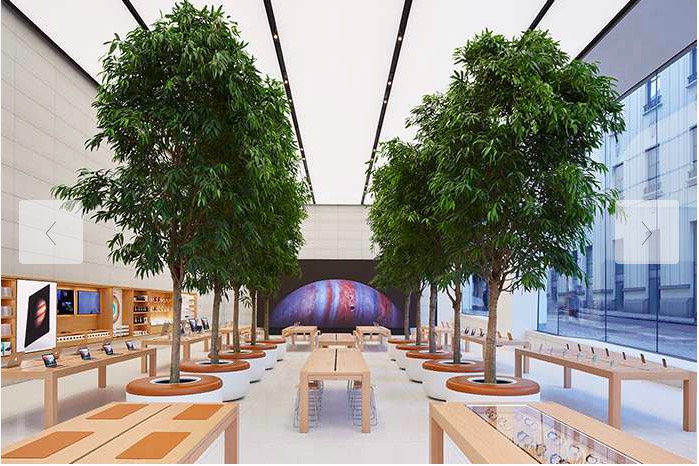
That growth hasn’t been achieved solely by the retail stores themselves, despite Apple’s highly sophisticated approach to choosing, locating, and decorating all of its retail outlets. The entire experience is designed, down the curves use across the entire gamut of shops and the trees in those pots.
A video still circulating online showed then Apple CEO Steve Jobs, taking us on a tour around the store, showing how each section of the shop had been designed to represent a different part of Appe’s business.
Of course, the nature of that business changed a great deal just a few months later when Apple introduced the iPod, a device which became the heartbeat of a digital content zeitgeist the company leaned into to overcome Windows, build its services empire, and from which to introduce the epoch-making iPhone just six years after the first store opened for business.
What problem did it solve?
The company came in or a huge amount of criticism when it opened its first two retail stores in Virginia and California. Critics and competitors couldn’t understand why the company even needed stores.
I can explain that if you like: Apple had really loyal customers but suffered a distribution problem. Its products weren’t being showcased effectively even in the big chains that agreed to stock them, while the smaller retailers had the advantage of being specialised in Apple, along with the disadvantage of not operating at the same scale as the big chains.
Apple needed to escape from the shadows to push its brand across, and setting up shop in high foot traffic locations, peppered with some specialist stores on key streets, was the approach it took to do so.
Would it have worked without the iPod? I don’t know but what I do know is that those stores have attracted product launch queues ever since before that product shipped.
Even OS X attracted queues when it went on sale even before the opening of the first retail store. Apple knew it had a strong, loyal cohort of customers, and the stores became an extension of its relationship with them.
That’s entertainment, I suppose.
Apple store and the platform for growth
Apple’s growth since then has been off the scale. The first stores offered just four key Apple hardware products: iMac, iBook, PowerMac G4 and the PowerBook.
You can still get an iMac today, but you can also purchase other Macs, iPhone, iPad, Watch, Vision, AirPods and myriad other services and devices.
You can still visit a Genius Bar to get help when you need it, and the stores have developed both a wide and narrow vertical approach to customer outreach. They are there to serve everyone, with specific offerings to specific users, such as creatives or business pros.
Digital transformation helped at Apple retail
Apple being a resolutely digital brand, you’d think it’s chain of brick and mortar stores would suffer in the face of the digital transformation of retail. That is not in fact the case, to a great extent, others have sought to emulate Apple’s retail store model, pivoting their own physical stores into becoming customer experiences.
Apple always says it sees its stores as village squares. Sad to say, others are less successful at turning their shops into something similar, which is why Apple retail currently generates around $5,500 per square foot per year, putting the company in a league of its own when it comes to retail performance.
That’s about twice as much revenue as generated by high-end luxury retailers such as Tiffany and means Apple’s retail stores are the most revenue-efficient shops on the planet. They’re the most revenue efficient stores for a reason – they focus on customers, sell customers what they want, and provide access to a giant ecosystem that, for all its rapid growth, still holds loyalty to the Macs it first put inside its shops 25-years ago.
What Jobs said
“It was very simple. The Mac faithful will drive to a destination, right? They’ll drive somewhere special just to do that. But people who own Windows—we want to convert them to Mac. They will not drive somewhere special. They don’t think they want a Mac. They will not take the risk of a 20-minute drive in case they don’t like it. But if we put our store in a mall or on a street that they’re walking by, and we reduce that risk from a 20-minute drive to 20 footsteps, then they’re more likely to go in because there’s really no risk. So we decided to put our stores in high-traffic locations. And it works,” said Steve Jobs in 2008.
History shows he was right.
You can follow me on social media! Join me on BlueSky, LinkedIn, and Mastodon.